

Intro
Most enterprise leaders know their systems are complex.
Far fewer truly understand how they work.
This gap , between what leaders think their systems do and what actually happens behind the scenes , is one of the biggest reasons AI initiatives stall, underperform, or fail entirely. Before AI can responsibly automate, optimize, or make decisions inside an enterprise, it needs something most organizations don’t have: a living understanding of how their systems behave today.
That understanding lives in metadata, and at Tribal, this is exactly the problem we set out to solve.
Metadata: The Invisible Blocker Inside Enterprise Systems
When new CIOs or heads of IT step into an organization, they inherit decades of decisions , custom logic, integrations, fields, workflows, permissions, and undocumented dependencies. The challenge isn’t a lack of ambition. It’s a lack of visibility.
Without knowing what exists, how components are connected, or what will break if something changes, leaders are forced to move slowly or take risks blindly. This becomes especially dangerous when AI enters the picture.
From Tribal’s perspective, this lack of metadata intelligence is one of the most common , and least visible , blockers to enterprise change. AI doesn’t fail because models aren’t powerful enough. It fails because systems don’t provide enough context to act responsibly.
What A Metadata Fabric Actually Does And Why Tribal Built One
At its simplest, a metadata fabric creates a complete, connected map of how an enterprise system works.
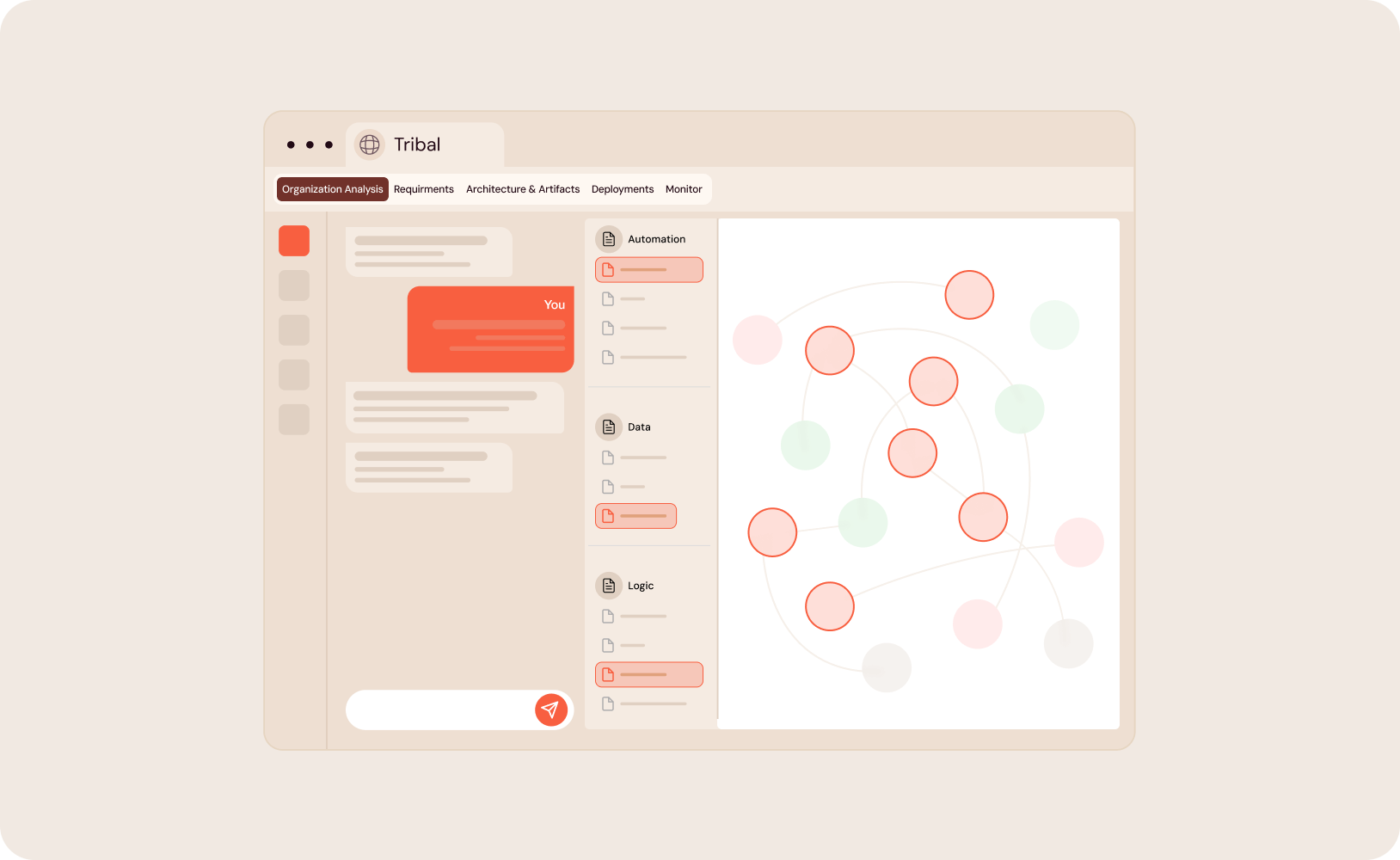
Tribal’s metadata fabric continuously ingests and understands the metadata that defines system behavior: fields, logic, flows, user interfaces, permissions, integrations , everything that explains how data moves, changes, and impacts downstream processes.
But visibility alone isn’t enough. The real power comes from understanding relationships.
Tribal doesn’t just show components in isolation. It documents how they interact:
- If this field changes, what else is impacted?
- If a process is modified, which users or workflows are affected?
- If a new initiative starts, what existing logic must be considered?
This relationship-aware view is what allows teams to move from “what exists” to “what happens if we change it.”
Why Point-In-Time Analysis Isn’t Enough
Many enterprises already use analysis or scanning tools. These tools can be useful, but they operate as snapshots.
They run once.
They generate reports.
They quickly become outdated.
Enterprise systems change constantly. Admins adjust configurations. Implementers introduce new logic. Integrations evolve quietly. Tribal was built on the belief that understanding must be continuous, not episodic.
That’s why Tribal’s metadata fabric is always on, tracking changes as they happen, updating documentation automatically, and ensuring that every new project starts with the most accurate context possible.
This shift , from static analysis to living system intelligence, is what makes responsible speed possible.
Why Metadata Is Foundational To Real AI Readiness
Most AI transformation programs begin with an “AI readiness assessment.” From a product perspective, the successful ones consistently get two things right.
First: data quality.
If the data is wrong, AI will amplify the problem.
Second , and just as critical , metadata intelligence.
AI agents don’t just need access to data. They need to understand:
- What they’re touching
- Why it exists
- How it’s meant to behave
- What impact their actions might have
This is where Tribal’s metadata fabric becomes a foundational layer for AI. It provides the guardrails that allow agents to operate with intent, not guesswork. Without those guardrails, it’s easy to demo impressive AI behavior , and just as easy to put something into production that causes real damage.
Metadata is what turns AI from a demo into something enterprises can trust.
Speed Comes From Context, Not Shortcuts
One of the most surprising outcomes Tribal customers see isn’t just faster delivery, it’s fewer surprises.
Questions that used to slow teams down become easy to answer:
- What does this component actually do?
- Why can’t this user access that data?
- What happens if we change this logic?
More importantly, teams stop rebuilding context from scratch. Tribal allows architects, analysts, and developers to start every change with a shared, up-to-date understanding of the system.
Each change then feeds back into the metadata fabric, making the next decision easier, safer, and faster. Speed becomes cumulative , not chaotic.
From Understanding To Innovation
Once teams stop fighting uncertainty, they start building more ambitious solutions.
With clear metadata context provided by Tribal, organizations are creating applications with:
- Deep business logic
- Sophisticated decisioning and routing
- Seamless experiences for both humans and AI agents
These aren’t simple configurations. They’re complex, integrated systems, made possible because the underlying architecture is understood, documented, and continuously evolving alongside the business.
Applications stop being one-off projects and start becoming living systems.
Why This Changes How Enterprises Evolve
Enterprise systems have always changed. What’s new is the expectation that they must change quickly , without breaking.
Without metadata intelligence, organizations face a tradeoff: move slowly to stay safe, or move fast and accept risk
Tribal was built to remove that tradeoff.
By acting as a continuously updated metadata fabric, Tribal gives enterprises the clarity and confidence to evolve their systems responsibly, and to unlock the full potential of AI along the way.
See The Metadata Fabric In Action
Understanding metadata conceptually is one thing. Seeing how it works inside real systems is another.
Watch the Tribal demo to see how a living metadata fabric helps enterprises design change, assess impact, and make AI-ready decisions, before anything breaks.
.png)

